Custom Offsets carries wheels and tire packages, suspension, performance parts, and accessories for the 1987 Acura Integra, all with verified fitment for the DA1 and DA3 chassis.
See what other owners are running on their 1987 Acura Integra – real fitment data from real cars.
No scripts. No call centers. Our team builds and drives the same cars you do — every recommendation comes from real-world experience. We’re not selling you a part, we’re helping you build your car.


The first-generation Acura Integra launched in 1986 as one of the two debut models for the Acura brand in the US, alongside the Legend. Built on the DA1 and DA3 chassis and sold through 1989, it came exclusively as a three-door hatchback liftback in the US market across RS, LS, and LS Special Edition trims. What made it stand out at launch was its 1.6-liter DOHC 16-valve four-cylinder engine, a genuinely rare feature in an entry-level car at the time. The engine itself evolved mid-generation: the 1986-1987 'Browntop' gave way to the revised 1988-1989 'Blacktop,' which brought lighter internals, higher compression, and an electric advance distributor for a modest bump in output. Four-wheel disc brakes, reworked suspension calibration, and a chassis closely related to the Civic but tuned for a more sport-oriented feel made this car a legitimate driver's platform from day one. Car and Driver put it on their 10Best list in 1987 and 1988. Nearly 228,000 units sold in four years, and the enthusiast community around these cars has never really cooled off.
Running the factory suspension, the DA1/DA3 sits on a well-sorted double-wishbone setup front and rear. The stock geometry is already a strong starting point for a clean, daily-driven build. At this height, the fitment window supports 14- to 18-inch wheels with widths from 5.5 to 7.5 inches and offsets in the +38 to +45 range, keeping the wheel face sitting close to flush with the factory bodyline. Tire sizes in the 185 to 215 width range pair well across that wheel diameter spread. No modifications needed; it drives right out of the gate.
A set of lowering springs drops the DA1/DA3 a measured amount over the factory struts, tightening up the wheel gap and giving the car a noticeably more planted stance without committing to a full suspension overhaul. The double-wishbone geometry responds well to a modest drop, keeping handling predictable. This is the entry point for builders who want a cleaner look and a slightly firmer, more connected feel on the street while keeping daily usability intact. Suspension bushings are a smart companion upgrade here to sharpen up the geometry.
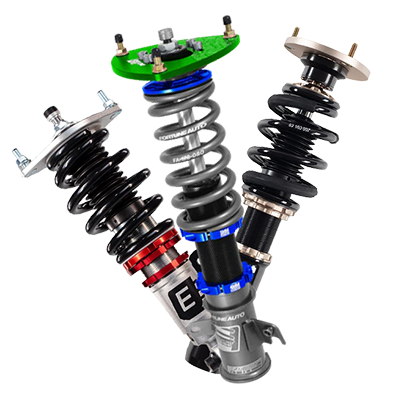
Adjustable coilovers are the move for builders who want full control over ride height, spring rate, and stance. On the DA1/DA3 chassis, a quality set of height-adjustable coilovers lets you dial in exactly how the car sits, from a clean street drop to an aggressive low stance. The documented setup our customers run on coilovers is a 15x7 +38 wheel with a 205/50R15 tire, a setup that works well with the reduced ride height and keeps the proportions looking intentional. Pair with fresh alignment and upgraded bushings for the full effect.
The 1.6-liter DOHC four-cylinder on the DA1/DA3 responds well to improved airflow. An aftermarket air intake replaces the restrictive factory airbox with a freer-breathing setup, sharpening throttle response and adding a more pronounced induction sound under acceleration. On a high-revving DOHC engine like the D16A1, the difference in how the car pulls through the rev range is noticeable. It is one of the simplest bolt-ons on the platform and a natural first step for anyone building toward more performance.
A cat-back exhaust replaces everything downstream of the catalytic converter, leaving the cat itself in place. On the 1.6-liter four-cylinder, the result is a sportier, more vocal exhaust note and reduced backpressure through the system. The DA1/DA3 responds well to a free-flowing cat-back: the engine breathes more easily at higher rpm, which is where this DOHC unit likes to live. Mid-pipe options are also available for this platform if you want to address the section between the header and the cat-back system.
Beyond intake and exhaust, the DA1/DA3 has a solid catalog of bolt-on performance parts. Upgraded brake rotors and pads sharpen stopping power, a worthwhile upgrade on a car that was already spec'd with four-wheel discs from the factory. Clutch kits and drivetrain components keep the power delivery clean as the build progresses. Valve components, ignition upgrades, and fuel system parts round out the engine performance side. For builders going deeper, intake manifolds and pistons and rods are available for this chassis. A supporting ECU tune helps the combination reach its potential when multiple bolt-ons are stacked.
The 1987 Integra's clean hatchback lines and pop-up headlight front end give it a distinct character that rewards thoughtful visual upgrades, from lighting retrofits that modernize the look to exterior and interior touches that sharpen the build.
The DA1/DA3's pop-up headlight setup is iconic, but the factory lighting output is dated by modern standards. Upgraded bulbs are a straightforward improvement that brings the output closer to what modern drivers expect without changing the look of the car. For builders going further, headlight retrofits and lighting accessories let you modernize the front end while keeping the period-correct silhouette. Sequential or LED signal upgrades add a contemporary touch to the exterior presence. Interior ambient lighting is a popular addition for the show-build crowd, adding visual depth to the cabin at night.
On the exterior, aero components and body accessories are available for the DA1/DA3, letting builders refine the lines of the hatchback body. A rear bumper upgrade is an option for builders looking to clean up the tail end. Windshield replacement is available for this chassis as well. Inside, the 1987 Integra cabin is compact and driver-focused. Custom floor mats and liners protect the carpet and keep the interior looking clean, a practical first step for any build. Floor carpet upgrades and interior styling pieces let you take the cabin further. Seat brackets and sliders open up options for aftermarket seat fitment, a natural move for builders who want a more aggressive seating position. Shift knobs are a small but tactile upgrade that makes the driving experience feel more intentional on a car you row through the gears regularly.
Good: Lowering springs over factory struts for a cleaner stance and tighter wheel gap. Better: Height-adjustable coilovers with independent spring rate and ride-height control. Best: Full coilover setup with upgraded bushings and alignment-correction hardware for dialed geometry at an aggressive drop.
Good: Cold air intake for sharper throttle response and better induction sound. Better: Intake paired with a cat-back exhaust for improved flow and a sportier exhaust note. Best: Full intake and exhaust combination with upgraded ignition, fuel components, and a supporting ECU tune to optimize the whole package.
Good: Upgraded bulbs and basic body accessories for a cleaner, more polished look. Better: Aero components, rear bumper upgrade, and headlight retrofits to modernize the front end and sharpen the body lines. Best: Full exterior package with sequential lighting upgrades, aero bodywork, and interior-visible lighting accents for a complete show-build presentation.
Good: Custom floor mats and liners to protect the cabin and keep it looking clean. Better: Floor carpet upgrade, shift knob, and interior styling pieces for a more intentional cockpit feel. Best: Full interior build with seat brackets for aftermarket seating, ambient lighting, and complete protection and styling throughout the cabin.
Good: 15x7 +38 with 205/50R15 on stock suspension, a clean flush fitment that sits right in the verified window for this chassis. Better: 15x7 +38 with 205/50R15 on lowering springs, the same proven combo that tucks tighter with the reduced ride height for a more intentional stance. Best: 15x7 +38 with 205/50R15 on coilovers, the documented setup our customers run at this height, dialed in with full ride-height control for the stance you want.
Good: Clean, daily-driven, and sharp. A 1987 Integra that looks intentional and drives better than stock without sacrificing usability. Better: A committed street build with real stance and a performance edge. The kind of car that gets noticed at a meet without being impractical on the commute. Best: A show-ready DA1/DA3 built with purpose. Low, dialed, and finished throughout. Every detail considered, every upgrade chosen to reinforce the same intent.
It depends on your goal. Builders focused on stance and presence often start with suspension, getting the ride height dialed before choosing wheels and tires to match. Others start with wheels and tires first to establish the look, then adjust suspension around the fitment. Performance-first builders go intake and exhaust early. There is no single right order. Start with the category that matters most to your build vision and build outward from there.
Yes. Get pre-approved before you start building your cart so you know your budget going in. Pre-approval is fast and does not require you to have a specific order ready. Once you know what you are approved for, you can build your cart with confidence and check out knowing the numbers already work. Spreading the cost over time makes it easier to do the build right the first time rather than compromising on parts.
Absolutely. Our fitment team knows the DA1/DA3 chassis and can help you confirm what clears at a given drop, which wheel and tire combos work with your suspension setup, and what to expect from a specific offset at your ride height. On the install side, we can point you toward the right sequence for a coilover swap or a brake upgrade so nothing gets missed. Reach out before you order if you have questions about a specific combo.
We carry verified fitment parts for the DA1/DA3 chassis across suspension, performance, brakes, exhaust, and interior. Every wheel and tire package we sell is matched to this platform's bolt pattern, hub bore, and offset range so you are not guessing. Our customer build community gives you real-world proof of what works on cars like yours. We own the fitment from the first question to the final install, not just the sale.