What Wheels and Tires Best Fit a 1989-98 OBS Chevrolet K1500?
September 15, 2026
Quick Answer
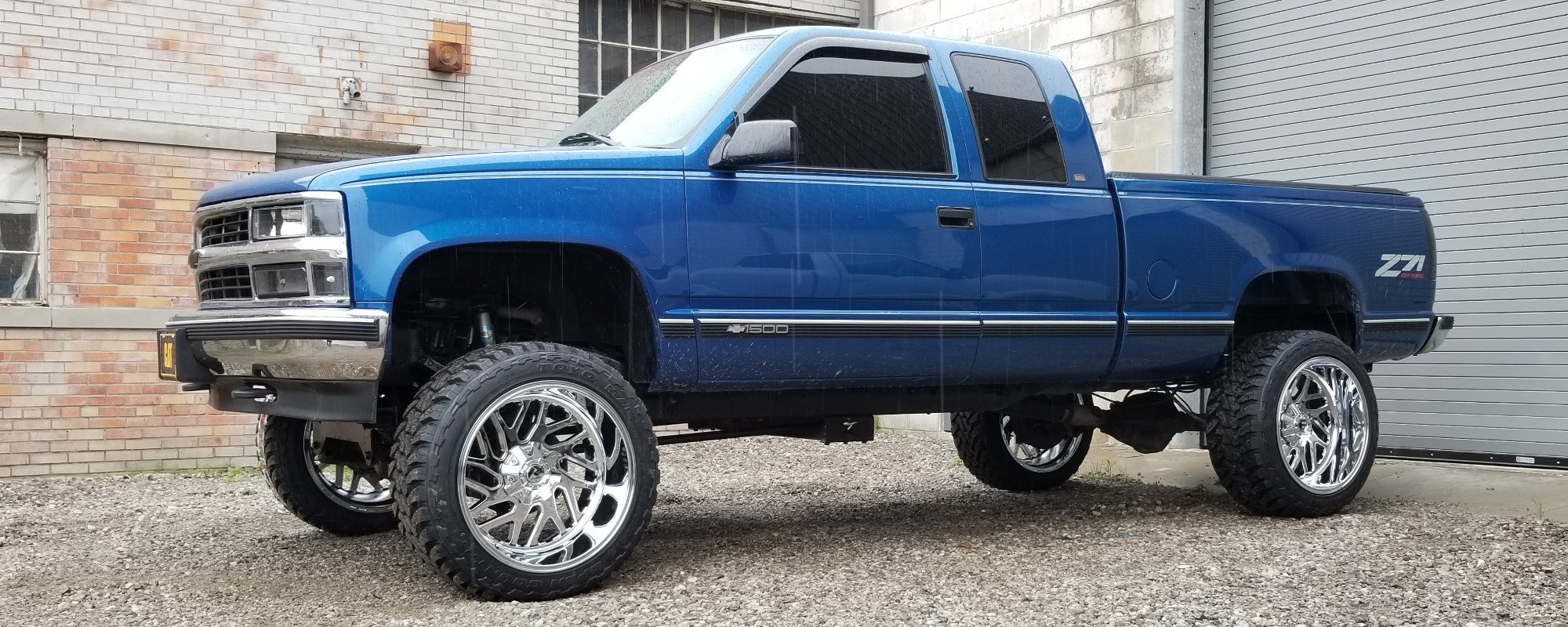
Before anything else, count your lug nuts. The 4WD K1500 is 6x139.7 and the 2WD C1500 is 5x127, and those wheels do not swap. On a K1500, the three setups our gallery sees most are 9-wide at -12 with a 33x11.5 on a leveling kit, 10-wide at -24 with a 33x12.5 on a 4-inch lift, and 12-wide at -44 with a 35 on a 6-inch lift.
The OBS is the cheapest way into a truck that people still stop and look at, and the fitment is more forgiving than anything built since. The catch is that "OBS 1500" describes two different trucks with two different bolt patterns, and most of the guides out there only cover one of them. This one covers both, with real setups off real builds, plus the stock numbers, the rub points, and what the torsion bars will and will not do for you.
Count Your Lug Nuts Before You Shop
This is the single most expensive mistake on an OBS, and it happens constantly because the two trucks look identical from ten feet away.
| Truck | Bolt Pattern | Notes |
|---|---|---|
| C1500 (2WD) | 5x127 (5x5") | Five lugs, coil spring front. The street truck half of the OBS world. |
| K1500 (4WD) | 6x139.7 (6x5.5") | Six lugs, torsion bar front. This is what the original version of this guide covered. |
| 2500 / 3500 | Usually 8x165.1 (8x6.5") | Count them anyway. Light-duty 7200 GVWR 2500s left the factory with six lugs, so the badge does not tell you. |
Neither pattern changed at any point between 1988 and 1998. A 5-lug C1500 wheel will not go on a 6-lug K1500 and there is no adapter worth running to make it happen on a daily truck.
6x139.7 is the same pattern GM used on 1500s all the way through 2018, so a set of takeoffs from a much newer Silverado will bolt to a K1500. Bolting on is not fitting, though. Newer wheels run positive offset and a larger hub bore, so you will tuck them under the fender and you may need centering rings. Check the offset before you buy somebody's takeoffs.
Both trucks use M14x1.5 studs with a 60-degree conical seat, which is the standard aftermarket lug nut. The factory capped two-piece lug nuts on these trucks swell and round off with age, so budget for a fresh set with your wheels. Hub bore is 78.1mm, which is what every hub-centric spacer and centering ring vendor builds to for this platform. GM never published a bore figure, so that number comes from measurement rather than a factory document.
On lug torque: the published spec changed during this generation, and the figures floating around forums for a 1988 truck and a 1997 truck are not the same number. Pull the spec for your exact year out of a service manual rather than copying one off a thread. We are not printing a figure here because the sources we could find contradict each other and a wheel is not the place to guess.
What Came On It From The Factory
Useful for two reasons. It tells you how far you are actually moving from stock, and it tells you what a spare will and will not fit.
| Truck | Factory Wheels | Factory Tires |
|---|---|---|
| C1500 (2WD) | 15x6 and 15x7 steel, 15x7 ten-slot alloy | P225/75R15 base, P235/75R15 common. The 1990 to 1994 454SS ran 275/60R15. |
| K1500 (4WD) | 16x6.5 steel, 16x7 five-spoke alloy | LT225/75R16 and LT245/75R16. Z71 off-road package got LT265/75R16, roughly 31.6 inches tall. |
Worth knowing: there was no factory 15-inch 6-lug wheel on the K1500. It was a 16-inch truck from day one. If somebody tells you their K1500 came with 15s, they are thinking of a C1500 or a different truck entirely.
We are deliberately not printing factory offset or backspacing figures. The only published numbers we could find come from a dataset that looks like it was built for export-market fitments, and the figures in it do not match what OBS owners report measuring off their own trucks. Publishing a number we cannot stand behind is worse than leaving it out.
K1500 Setups That Work (4WD, 6-Lug)
These three tiers come out of our own gallery, which has over 100,000 real builds in it. They are what the most people are actually running at each suspension height, not what looks good on paper.
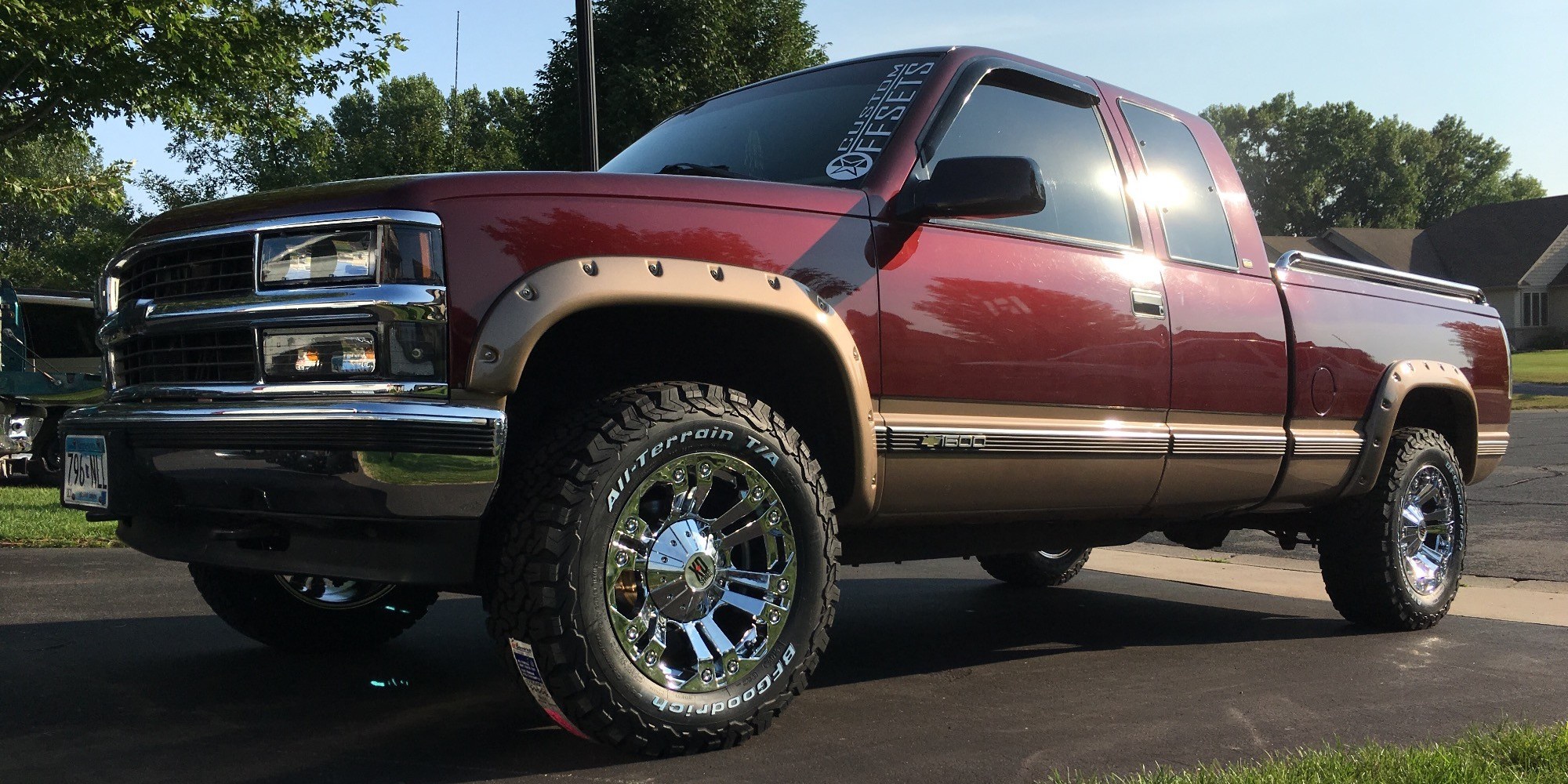
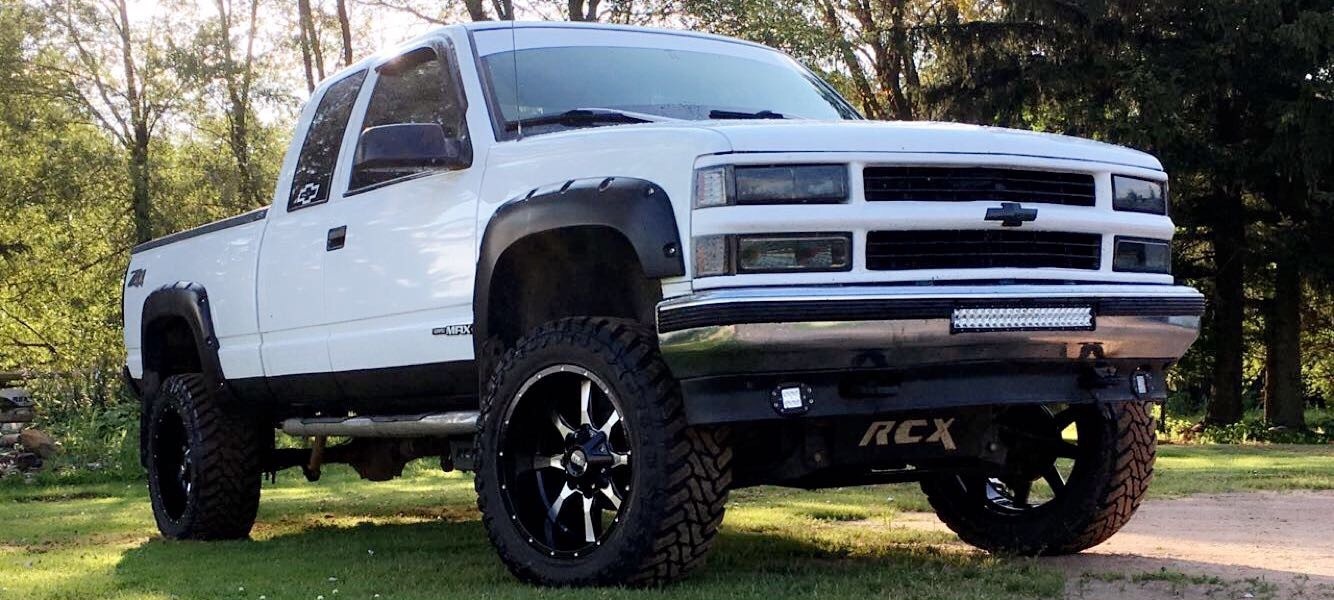
9-Wide, -12 Offset, 33x11.5
The entry point, and it fits with almost nothing done to the truck. 33x11.5 is the same size as a 295/55, and our site converts between the two automatically if you shop in metric.
- Width and offset 9 inches wide, -12mm offset.
- Tire 33x11.5, or 295/55 in metric.
- Expect a little poke past the fender, which is the point.
10-Wide, -24 Offset, 33x12.5
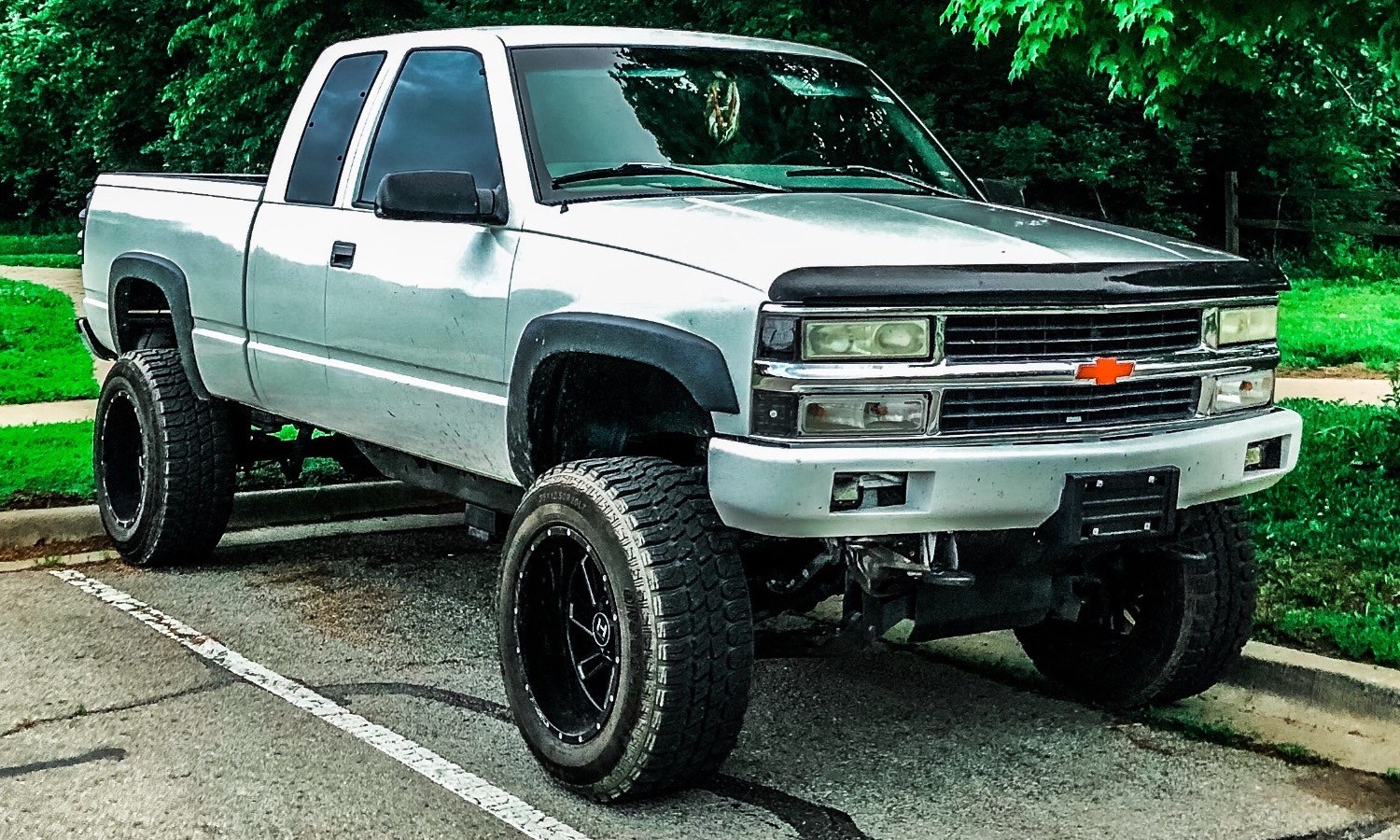
A four-inch suspension lift is the most common small lift on an OBS in our data, and this is the setup that goes with it. The reason this tier matters is that an OBS takes a 33 on a four-inch lift without a fight, where a modern truck at the same height has you cutting the inner fender to make it work.
- Width and offset 10 inches wide, -24mm offset.
- Tire 33x12.5.
- Lift A real four-inch suspension kit, not a block and a level stacked together.
12-Wide, -44 Offset, 35s
Six inches is where most OBS builds stop, and it is the right place to stop. The truck has the proportions to carry a 35 without needing a foot of lift to get there, which is why a well-done six-inch OBS reads as bigger than a modern truck at the same height.
- Width and offset 12 inches wide, -44mm offset.
- Tire 35 inch, commonly 35x12.5.
- Narrower alternative The gallery is full of 9-wide -12 builds running the same 35 with far less poke. Same height, different attitude.
Real K1500 Builds At Each Height
Every one of these is a live entry in our gallery with the wheel, tire, and suspension recorded by the owner.
| Build | Wheel | Tire | Suspension |
|---|---|---|---|
| 1988 K1500 | 16x8 -6 | 33/10.5R16 | OEM stock |
| 1993 K1500 | 16x9 -12 | 285/75R16 | OEM stock |
| 1994 K1500 | 20x12 -44 | 305/50R20 | OEM stock |
| 1996 K1500 | 20x12 -44 | 33x12.5R20 | Leveling kit |
| 1993 K1500 | 20x9 -12 | 35x12.5R20 | 6-inch lift |
| 1997 K1500 | 17x9 -12 | 37x12.5R17 | 6-inch lift |
Look at that 1994 on stock suspension running a 20x12 -44 with a 305/50R20. A 305/50R20 is only about 32 inches tall, so the truck is carrying the width without the height. That is the OBS trick: because the fenders sit high relative to the tire, you can run an aggressive offset at stock ride height and get away with it.
C1500 Setups And Lowered Trucks (2WD, 5-Lug)
Half the OBS world is a 2WD on the ground, and it plays by opposite rules. A lifted truck wants negative offset to push the wheel out. A lowered truck wants the wheel tucked under the fender, which means positive or near-zero offset and a narrower tire, because there is no room out there once the body comes down.
| Build | Wheel | Tire | Suspension |
|---|---|---|---|
| 1998 C1500 | 18x9 0 | 265/60R18 | OEM stock |
| 1995 C1500 | 15x8 -13 | 31/10.5R15 | Leveling kit |
| 1993 C1500 | 15x10 -44 | 32/11.5R15 | 4-inch lift |
| 1993 C1500 | 15x10 -46 | 33x12.5R15 | 5-inch lift |
| 1990 C1500 | 15x10.5 -20 | 25/10.5R15 | Lowered 2" front, 4" rear |
| 1993 C1500 | 18x8.5 +10 | 235/55R18 | Lowered 4" front, 6" rear |
| 1994 C1500 | 20x8.5 +19 | 255/45R20 | Lowered 6" front, 8" rear |
Read down the lowered rows and the pattern is obvious. As the drop gets deeper, the offset climbs and the tire gets narrower and shorter. The 6/8 drop is on an 8.5-inch wheel at +19 with a 255/45R20, which is a passenger-car-width tire. The 2/4 drop with the 15x10.5 at -20 is the drag-style exception, and it works because a 2/4 is barely lowered and that truck is running a 25-inch tall tire.
The 4WD guys are not locked out of this either. There is a 1995 K1500 in the gallery lowered 4 and 6 on 17x9 +1 with a 275/50R17, which is a 6-lug truck on the ground. Rare, and it looks right.
What Rubs, And What You Can Do About It
The original version of this guide said wheel diameter does not affect fitment at all. That is right about poke and wrong about clearance, and the difference matters if you are shopping 15s.
Diameter Does Not Change Poke
A 15x9 at -12 and a 20x9 at -12 stick out exactly the same amount, because width and offset are what set where the wheel sits, not diameter. Two wheels with the same width and the same offset put the tire in the same place. That part of the original guide is correct and it is the single most useful thing to understand about fitment.
Diameter Does Change Brake Clearance
Going down to a 15-inch wheel on a K1500 is a different question. Owners running 15s over the stock front brakes report mixed results: plenty fit clean, and others have had to take a die grinder to the caliper or the caliper mounting bracket to clear the barrel. Steel wheels generally clear better than cast alloys because of how the barrel is shaped near the mounting pad. The variable is the wheel's inner barrel profile and backspacing, not the diameter number on the box, so test fit before you commit to a set of 15s. If you have already upgraded the front brakes, check the kit's minimum wheel diameter, because some big brake kits are built specifically to clear 15s and others are not.
Where An OBS Actually Rubs
Going wide and tall, the contact points are the back edge of the front fender opening, the plastic inner fender liner, and the lower valance or air dam. On a lowered truck it is the fender lip itself at the top of the tire. The usual fixes, in order of how much you are committing: trim or remove the inner liner, roll the fender lip, then cut the valance. Full lock plus reverse plus a driveway apron is the condition that finds every rub point at once, so test there rather than in a parking lot.
Cranking The Torsion Bars (K1500 Only)
The 4WD K1500 uses independent front suspension with torsion bars, and it was the first American full-size 4x4 to do it. That is why OBS 4x4 fitment behaves nothing like a solid-axle truck. It also means the front ride height is adjustable with a wrench and no parts.
Owners consistently report getting about an inch and a half to two inches of usable lift out of a crank. Roughly three inches is the mechanical limit and essentially nobody recommends living there. The reason is that cranking does not add spring, it consumes down travel. The truck rides on progressively less suspension until you are effectively sitting on the bump stops, and the complaints are consistent and colorful. It also puts the CV shafts at steeper angles than they were designed for, which shortens their life and the life of the ball joints.
A crank is a legitimate free way to level a K1500 and clear a taller tire. It is not a substitute for a lift kit if you are chasing 35s. If you crank it, budget for an alignment immediately after, because you have changed camber and caster, and check that both sides came up evenly.
The 2WD C1500 runs coil springs up front and has no torsion bars to adjust, so this section does not apply to it.
OBS Chevy Fitment FAQ
Do OBS 2WD and 4WD wheels interchange?
No. The 2WD C1500 is 5x127 and the 4WD K1500 is 6x139.7, so the wheels do not swap between them. Neither pattern changed at any point from 1988 through 1998. Count the lug nuts on the truck before you buy anything, because the two trucks look the same from a distance and a badge on the fender will not tell you.
What is the OBS Chevy bolt pattern and hub bore?
K1500 (4WD) is 6x139.7, also written 6x5.5 inches. C1500 (2WD) is 5x127, also written 5x5 inches. Hub bore on both is 78.1mm, which is the figure hub-centric spacers and centering rings for this platform are built to. Studs are M14x1.5 with a 60-degree conical seat on both trucks.
What is the biggest tire that fits an OBS with no lift?
Our gallery has stock-suspension K1500s running 33-inch tires, including a 1993 on 16x9 -12 with a 285/75R16 and a 1988 on 16x8 -6 with a 33/10.5R16. Going wider than that at stock height usually means trimming the inner fender liner and the lower valance. The fenders sit high on an OBS relative to the tire, which is why they take a 33 more easily than a modern truck does.
Will 35s fit an OBS Chevy?
Yes, on a six-inch suspension lift, which is what most 35-inch OBS builds in our gallery are running. The most common setup at that height is a 12-wide wheel at -44 offset. If you want less poke, plenty of six-inch builds run the same 35 on a 9-wide at -12 instead. Six inches is also where most OBS builds stop, because the truck's proportions carry a 35 without needing more lift than that.
What year did the OBS Chevy start and end?
The GMT400 platform C/K pickups ran from the 1988 model year through 1998. The GMT800 Silverado arrived for 1999, but GM kept selling the old body alongside it as the C/K Classic in fleet configurations, with production of some cabs continuing into the 2000 model year. So a 1999 or 2000 badge does not tell you which body you are looking at. The Suburban and Tahoe moved to this platform later than the pickups did, in 1992 and 1995 respectively.
Will newer Silverado wheels fit an OBS K1500?
They will bolt on, because GM used 6x139.7 on 1500s through 2018. Whether they fit the way you want is a different question. Newer wheels are built with positive offset for trucks with different fender geometry, so they will sit tucked under an OBS fender rather than filling it. Newer GM wheels also tend to have a larger hub bore, so you may need centering rings. Check the offset stamped on the back before you buy a set of takeoffs.
What wheel offset works on a lowered OBS?
Positive or near-zero, and narrower than you would run lifted. Gallery builds show a 4/6 drop on 18x8.5 at +10 with a 235/55R18, and a 6/8 drop on 20x8.5 at +19 with a 255/45R20. As the drop gets deeper the offset climbs and the tire gets narrower and shorter, because there is no clearance out at the fender lip once the body comes down. The exception is a mild 2/4 drop, where a wide wheel at negative offset still works with a short tire.
Does wheel diameter change how far the wheel sticks out?
No. Width and offset set where the wheel sits, so a 15x9 at -12 and a 20x9 at -12 poke exactly the same amount. Diameter does matter for one thing though, and that is clearing the brakes. Dropping to a 15-inch wheel on a K1500 can put the inner barrel into the front caliper or its mounting bracket depending on the wheel's shape and backspacing, so test fit a 15 before you buy four of them.
What wheels and tires came on an OBS from the factory?
The K1500 came with 16x6.5 steel wheels or a 16x7 five-spoke alloy, on LT225/75R16 or LT245/75R16 tires, with the Z71 off-road package getting LT265/75R16. The C1500 came with 15x6 and 15x7 steel wheels or a 15x7 ten-slot alloy, on P225/75R15 or P235/75R15, with the 1990 to 1994 454SS running 275/60R15. There was never a factory 15-inch 6-lug wheel on a K1500.
Shop Wheels And Tires For Your OBS
Tell us the year, whether it is a C or a K, and what suspension is under it, and we will tell you what fits instead of guessing at it. We have been documenting truck builds since 2012, with over 100,000 real setups and 1.25 million photos, so you can see your exact wheel and tire combination on somebody else's OBS before you spend a dollar. Free shipping to the lower 48, free mounting and balancing on wheel and tire packages, and financing as low as 0% APR through Affirm.
Stock Trucks Suck
Real photos, real offsets, real builds. See what fits your OBS before you buy.
Shop K1500 (4WD) Shop C1500 (2WD)More fitment guides
Bolt patterns, hub bore, stud size, factory wheel sizes and factory tire sizes reflect OEM wheel catalogs, established fitment databases, and manufacturer documentation. Setup recommendations at each suspension height come from the Custom Offsets fitment gallery. Torsion bar lift figures and rub points reflect owner-reported consensus from OBS communities rather than a factory specification, and are presented as such. Lug torque figures are deliberately omitted because published sources for this generation conflict by model year. What are you running?