How to Read a Tire Sidewall
June 21, 2019
Whether you're new to the truck world or you've been around the block, knowing how to read the sidewall of a tire is essential. The numbers and letters on every tire tell you everything from size to load capacity to manufacturing date — and reading them correctly is the difference between buying the right tire and ordering one that doesn't fit.
There are two main tire sizing systems you'll run into: metric (also called P-metric or LT-metric) and flotation (also called standard or LT-flotation). They look different, and they're read differently. Let's break them both down.
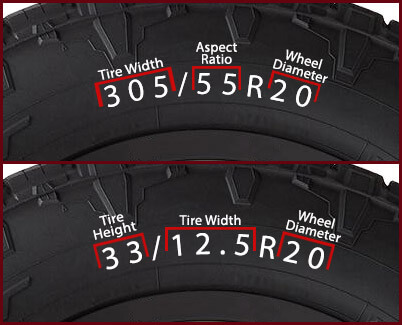
Metric Tire Sizing (e.g., 275/65R20)
This is the most common tire sizing format in the U.S. — you'll find it on stock tires for nearly every modern passenger vehicle and most truck OEMs. Here's what each number means, using 275/65R20 as our example:
- 275 = Section width in millimeters. This is how wide the tire is from sidewall to sidewall when mounted on its specified rim.
- 65 = Aspect ratio. This is the height of the sidewall expressed as a percentage of the section width. So a 65 aspect ratio on a 275-wide tire means the sidewall height is 65% of 275mm — roughly 179mm tall.
- R = Construction type. R stands for radial — the universal modern standard. You'll occasionally see D (diagonal/bias-ply) on older or specialty trailer tires.
- 20 = Wheel diameter in inches. This is the size wheel the tire is designed to mount to.
If the size starts with a letter — like P275/65R20 or LT275/65R20 — that letter tells you the tire's intended use:
- P = Passenger (P-metric)
- LT = Light Truck (heavier-duty construction, higher load ratings)
- ST = Special Trailer (NOT for passenger or truck use)
- No letter = Euro-metric (similar to P-metric but slightly different load rating calculations)
For trucks, LT-metric tires are the workhorse choice — they're built tougher and rated for higher loads than passenger tires. If you're towing or hauling, LT is the move.
Flotation/Standard Tire Sizing (e.g., 33x12.50R17)
The "big tire" sizing format you'll see on most aftermarket truck tires. Same example tire: 33x12.50R17.
- 33 = Overall tire diameter in inches. This is the full diameter of the tire — top to bottom, not just the height above the wheel. So a 33-inch tire is 33 inches tall, end to end, when properly inflated and unloaded.
- 12.50 = Section width in inches. This is how wide the tire is from sidewall to sidewall.
- R = Radial construction.
- 17 = Wheel diameter in inches.
Heads up: the first number in flotation sizing is the overall diameter, NOT the height from ground to top (which would be the radius). A common mistake is to read a 33x12.50R17 as a tire that sits 33 inches above the ground — it doesn't. It's 33 inches across, and roughly 16.5 inches from the ground to the top of the tire (give or take, depending on the actual measured dimensions, which can vary from the stated size).
Don't want to try and figure out the differences? We made some calculators help out. Check them out here.
Load Index And Speed Rating
After the size, you'll see a number-letter combo like 121/118S. This is the service description.
Load Index = the number portion. It's a coded value that corresponds to maximum load capacity. A load index of 121 means each tire can support roughly 3,297 lbs at maximum inflation. The higher the number, the more weight it can carry. Reference the standardized load index chart — load index 100 = 1,764 lbs, 110 = 2,337 lbs, 120 = 3,086 lbs, etc.
On LT tires, you'll often see two numbers separated by a slash (e.g., 121/118). The first number is single-wheel capacity; the second is the dual-wheel capacity (lower because of mutual load redistribution between paired tires on duallies).
Speed Rating = the letter. This is the maximum sustained speed the tire can handle at its rated load. Most truck tires fall in the S-T range (S = 112 mph, T = 118 mph, H = 130 mph, V = 149 mph). Off-road tires often have lower speed ratings (Q = 99 mph) because aggressive tread patterns trade highway speed for grip.
For daily-driven trucks, the speed rating is rarely a real-world limit — but if you're loading down a truck for towing, the load index matters a lot. Don't downgrade load capacity when you're buying aftermarket.
Load Range (C, D, E, F)
Separate from load index, you'll see a letter like Load Range E or just E stamped on the sidewall of LT tires. Load Range corresponds to the old "ply rating" system (which is mostly a marketing holdover now — modern tires don't actually have ply counts that match the rating).
Common load ranges for trucks:
- C = 6-ply rated (lighter-duty)
- D = 8-ply rated (medium-duty)
- E = 10-ply rated (heavy-duty — the most common for 3/4-ton and 1-ton trucks)
- F = 12-ply rated (very heavy-duty)
Higher load range = stronger sidewalls = higher payload capacity, but also stiffer ride. Most half-ton trucks come with C or D range from the factory. HD trucks come with E or F.
The DOT Date Code: How Old Is Your Tire?
Every tire sold in the U.S. is required by federal regulation (49 CFR 574.5) to have a DOT (Department of Transportation) code. The DOT code includes the tire's manufacturing plant, size code, and most importantly, the date code showing when the tire was made.
How to find it: Look for DOT followed by a string of letters and numbers on the sidewall. The full code is usually only on one side of the tire — check the inner sidewall too if you don't see it on the outer.
The last four digits are the date code:
- The first two digits are the week of manufacture (01-52)
- The last two digits are the year
Examples:
- DOT code ending in 2424 = 24th week of 2024
- DOT code ending in 0521 = 5th week of 2021
- DOT code ending in 3719 = 37th week of 2019
Why this matters: Tires age even when they're not being used. Most manufacturers (Michelin, Bridgestone, Continental, etc.) recommend replacing tires after 6-10 years regardless of tread depth. The rubber compound degrades over time, and old tires are at higher risk of belt separation, tread blowout, and sidewall cracking.
When buying new tires, check the date code — you don't want a "new" tire that's been sitting in a warehouse for 4 years before it gets to you. Anything within the past 1-2 years is reasonably fresh.
UTQG Rating: Treadwear, Traction, Temperature
On passenger and many LT tires, you'll find a UTQG (Uniform Tire Quality Grading) rating — three values stamped on the sidewall, like 500 A B. This is a federally mandated grading system administered by the NHTSA.
- Treadwear (a number, often 200-800) = relative expected tread life. A treadwear of 400 means the tire is expected to last roughly twice as long as a tire rated 200. These ratings are manufacturer-tested, so they're not perfect, but they're useful for comparing tires within the same brand.
- Traction (AA, A, B, or C) = wet pavement stopping ability. AA is best.
- Temperature (A, B, or C) = heat resistance at high speed. A is best.
UTQG ratings don't apply to most off-road / mud-terrain tires (those are exempt under DOT rules), so don't worry if your aggressive MT doesn't have them.
M+S, 3PMSF, And Other Sidewall Markings
Some other markings you'll commonly see:
- M+S (or M/S) = Mud and Snow. This is a self-certified rating — the manufacturer just says the tire is designed for some snow/mud use. Most all-terrain and many all-season tires have this. It's not a strong indicator of actual winter performance.
- 3PMSF (Three-Peak Mountain Snowflake) = the actual severe-snow-service rating. This is a tested rating from the Rubber Manufacturers Association. Tires with this symbol have passed a standardized snow traction test. If you need real winter performance, look for 3PMSF, not just M+S.
- DOT = certifies the tire meets U.S. safety standards.
- MAX LOAD = maximum load at maximum inflation, stamped in lbs and kg.
- MAX PRESSURE = maximum cold tire pressure (NOT necessarily your truck's recommended pressure — always go by the door jamb sticker, not the tire sidewall).
Shop Truck Tires At Custom Offsets
Now that you can decode any tire sidewall, you're ready to make smarter buying decisions. Shop our truck tire inventory — we've got all-season, all-terrain, hybrid AT/MT, and mud-terrain options from top brands like Toyo, Falken, Nitto, Cooper, BFGoodrich, and more. Browse our tire store or check our tire size comparison calculator to see how different sizes will sit on your truck.